- The Follower Count Trap Nobody Talks About
- Where Community Actually Lives (Hint: Not on TikTok)
- Stop Collecting Subscribers. Start Identifying Superfans.
- World-Building Over Content Dumping
- IRL Is Not Dead. It's the Only Thing That's Real.
- The Amplification Problem: You Can't Be Everywhere
- Why Small Communities Compound Faster Than Big Audiences
The Follower Count Trap Nobody Talks About
There's a band with 80,000 Instagram followers who can't sell 200 tickets to a hometown show. And there's a band with 4,000 followers who sells out a 300-cap venue every time they announce a date. The music industry will tell you the first band is doing better. They're wrong.
Follower counts are a performance metric for the platforms, not for you. Every time you chase a number, you're optimizing for an algorithm that doesn't pay your rent, doesn't buy your merch, and definitely doesn't show up when it's raining on a Tuesday night in Cleveland. The people who show up are your actual community, and they are built, not accumulated.
The problem is that nobody teaches artists how to build them. The advice is always some version of "post consistently" and "engage with your audience." Which is like telling someone to "eat food" as a nutrition plan. Technically true. Completely useless. So let's talk about what actually works, why most platforms are set up to prevent it, and what a real community-building strategy looks like for an independent artist in 2026.
Where Community Actually Lives (Hint: Not on TikTok)
Here's the uncomfortable truth about social media: it is not a community platform. It is a broadcast platform with a comments section. The distinction matters enormously.
TikTok, Instagram, even YouTube, these are places where you talk at people. The algorithm decides who sees it. The platform owns the relationship. When your account gets shadowbanned, or the algorithm shifts, or the app gets regulated out of existence, that audience evaporates. You don't own any of it. You never did.
Real community lives in places where the relationship is direct and durable. Email lists. Discord servers. Patreon tiers. Text message clubs. Private Substack threads. These are the channels where your fans have actively opted in, where they expect to hear from you, and where no algorithm is deciding whether your message gets delivered. An email list of 500 engaged fans is worth more than 50,000 passive Instagram followers, and I'm not being hyperbolic. Open rates on a warm artist email list routinely hit 40 to 60 percent. Organic Instagram reach for a non-boosted post is often under 5 percent.
So the first strategic decision you have to make is: where are you actually building? Social media should be a funnel that drives people toward the community you own, not the destination itself. Use it to attract. Use your owned channels to retain.
The artists who figured this out early are the ones quietly selling out shows and moving merchandise without viral moments. They built a house. Everyone else is renting.
Stop Collecting Subscribers. Start Identifying Superfans.
Not all fans are equal, and pretending otherwise is a strategic mistake. Inside any artist's audience, there's a small percentage of people who are genuinely obsessed. They listen to every track within 24 hours of release. They share your music without being asked. They travel for shows. They buy the vinyl even though they don't own a turntable. They reply to your emails. These are your superfans, and they are worth ten times what a passive listener is worth, in revenue, in word-of-mouth, in community energy.
The industry forecast right now is pointing directly at this. Superfan culture is accelerating. A small but deeply engaged audience is driving more momentum than broad passive reach, and that gap is widening. Artists who treat every fan identically are leaving compounding value on the table.
The problem is that most artists have no idea who their superfans actually are. You can see follower counts. You can see likes. But you can't easily see who has streamed your music 200 times, clicked every link you've sent, and bought tickets to three consecutive shows. That data exists, it's just scattered across Spotify, your email platform, your ticket seller, and your Linktree, all owned by different companies who have no incentive to share it with you.
This is one of the things we built Fan Intelligence to solve. The idea is simple: pull all those signals together into one place so you can actually see who your real fans are, not just who clicked a link once. When you know who your superfans are, you can treat them differently. Early access. Personal messages. Limited drops. Invitations to be part of the creative process. That's not manipulation, that's just recognizing that some people genuinely want a deeper relationship with your music, and giving it to them.
Superfans don't appear from nowhere. You cultivate them by consistently delivering value, by being honest and specific rather than promotional, and by creating moments that feel personal even at scale. But you can't cultivate what you can't see.
World-Building Over Content Dumping
The content treadmill is one of the most demoralizing parts of being an independent artist in 2026. You're expected to produce an endless stream of posts, reels, stories, shorts, threads, and clips, all while also, you know, writing and recording music. Most artists burn out on this before they ever build any real momentum. And the cruel irony is that most of that content doesn't build community anyway. It's just noise that disappears in 24 hours.
What actually builds community is world-building. There's a reason the mystery rollout strategy is outperforming straightforward release announcements right now. Look at what's happening in psychedelic rock, a genre that's surging in 2026 partly because its artists understand atmosphere and narrative. Tame Impala doesn't just announce an album. They create a gravitational event. Packaging, a lo-fi psych act, earned Earmilk coverage on "Always Calling" not because they ran a perfect marketing campaign but because the release felt like entering a specific world. That's the difference.
World-building means having a consistent aesthetic, a recurring mythology, recurring characters, inside references that reward long-term fans. It means your band photos, your lyric choices, your email subject lines, and your social captions all feel like they come from the same place. Fans don't just listen to the music, they inhabit the universe around it. And when someone feels like they're inside something, they protect it. They recruit their friends. They become advocates without being asked.
This doesn't require a big budget. It requires intentionality. Pick a visual language and stick to it. Develop recurring themes in your lyrics and reference them publicly. Name things. Give your community a name. Give your superfans a title. Make the inside feel worth being inside of.
Content is what you post. World-building is what you create. One fills a feed. The other builds a culture.
IRL Is Not Dead. It's the Only Thing That's Real.
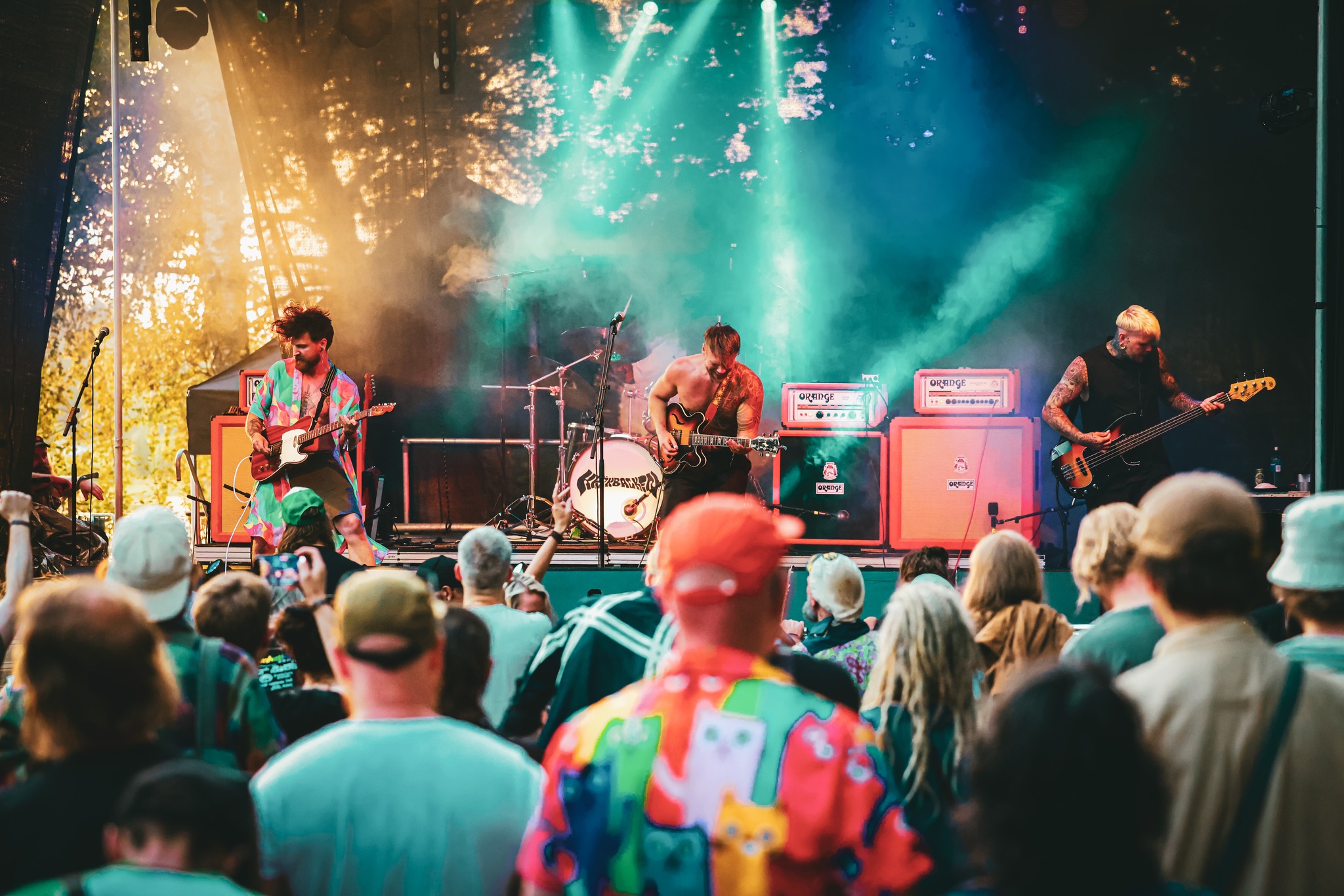
There's a generation of artists who built their entire career online and are now discovering that online fans don't convert to real-world support the way you'd expect. A million streams doesn't fill a 200-cap room. And a 200-cap room, filled with people who drove an hour to be there, is one of the most powerful community-building tools that exists. Algorithms cannot replicate it. They've tried.
IRL activations are surging as a trust-building mechanism right now, and it makes complete sense. When someone sees you perform, when they stand in the same room as you and feel the music physically, you become real to them in a way that no amount of content can achieve. And that realness is the foundation of loyalty. Not algorithmic loyalty. Human loyalty.
The mistake most artists make is treating live shows purely as revenue events. Shows are community events first. Revenue is a byproduct of community. So design your shows accordingly. Stay after. Learn names. Create moments that only the people in that room will ever experience. Make being there mean something.
The regional psychedelic scenes are a good model here. Colorado, Cincinnati, the Normaltown Festival circuit in Georgia, these scenes are producing credible artists with real local followings because they're embedded in physical communities. They play the same rooms repeatedly. They build relationships with local press. They create a home base before they try to conquer anything else. That's not a limitation. That's a strategy.
Start local. Go deep before you go wide. A city that genuinely claims you is worth more than a national audience that vaguely knows your name.
The Amplification Problem: You Can't Be Everywhere
Here's the structural problem with everything I've said so far. Community-building requires presence. Consistent presence. Across multiple platforms, across email, across live shows, across direct fan interaction. And you are one person, possibly with a day job, almost certainly without a marketing team, trying to also make music that's worth building a community around.
This is where most independent artists quietly give up. Not on music. On the community-building infrastructure. They post sporadically. They let the email list go cold for three months. They miss the window after a good show to follow up with new fans. And then they wonder why nothing compounds.
The solution isn't to work harder. It's to build systems that maintain presence when you're in the studio. Scheduled content. Automated email sequences. AI-assisted outreach. These aren't shortcuts. They're infrastructure. A venue has a sound system not because the musicians are lazy but because the room requires amplification.
The Social Autopilot feature on Indiependr exists specifically for this. Sixty-eight posts are already scheduled by artists on the platform right now, which means sixty-eight moments of presence that didn't require someone to stop what they were doing and open Instagram. That's not replacing authenticity. That's protecting the time and energy that authentic community-building actually requires.
Automation handles the cadence. You handle the moments that matter. The personal reply to the fan who's seen twelve shows. The handwritten note in the vinyl order. The surprise acoustic set at the record store. Those things cannot be automated, and they shouldn't be. But they're only possible if you're not drowning in the mechanical parts of maintaining visibility.
Why Small Communities Compound Faster Than Big Audiences
Here's the thing about community that the follower-count mentality completely misses: it compounds. A passive audience is linear. You add followers, you get proportionally more reach, the relationship is transactional and thin. A community is exponential. Every new member who becomes genuinely invested makes the community more valuable for every existing member. They bring their friends. They create content about you. They defend you in comment sections. They show up and their energy makes the room better, which makes the next person more likely to come back.
This is why the industry forecast is pointing toward superfan culture so aggressively right now. The math is changing. A hundred deeply engaged fans can generate more real-world momentum than ten thousand passive listeners. And a thousand of them can sustain a career.
The artists who are building on Indiependr right now, a small early group, are working through exactly this. They're not trying to go viral. They're building the infrastructure that makes community possible: analytics that surface who their real fans are, distribution that gets music to the right places, and tools that handle the mechanical parts of presence so the human parts can stay human. That's the entire philosophy. Not scale for its own sake. Scale in service of real connection.
The artists who win over the next five years won't be the ones with the biggest audiences. They'll be the ones with the most loyal ones. And loyalty isn't given. It's earned, slowly, through consistency, honesty, and the willingness to treat your fans like people instead of metrics.
Start there. Everything else follows.