The Gap Was Never About Talent
Here's something the major label system never wanted you to internalize: the reason most independent artists lose isn't because they're less talented. It's because they're outspent. A mid-tier major label act in 2026 has a marketing coordinator, a graphic designer, a social media strategist, a data analyst pulling Spotify for Artists dashboards, and a publicist who knows which Pitchfork editor is currently accepting submissions. An independent artist has a laptop, a day job, and maybe a friend who's "pretty good with Photoshop."
That resource gap is real, and pretending AI closes it completely would be dishonest. But something has genuinely shifted in the last 18 months. The tools that used to require a full-time hire, or a $3,000 agency retainer, are now accessible to anyone willing to learn them. And the artists who are figuring this out aren't just surviving. They're building actual careers.
Marketing Without a Marketing Department
The most immediate place AI has leveled the playing field is marketing copy and campaign strategy. Not because AI writes perfect press releases (it doesn't), but because it dramatically compresses the time between "I have a release" and "I have a coherent campaign." An independent artist can now generate a dozen different angle pitches for a new single, test messaging across social platforms, and iterate based on what's actually resonating, all without paying someone $75 an hour to think out loud in a strategy meeting.
The psychedelic rock scene is a useful case study here. Right now, the genre is fragmented across regional scenes in Cincinnati, Athens, and Detroit, driven almost entirely by independent artists rather than major label investment. That's actually an opportunity. When a genre is indie-dominated, the artist who figures out how to tell a coherent story about their music, and gets that story in front of the right people, wins. AI tools that help you draft that story quickly, and in multiple formats for different platforms, matter more in that context than in a genre with a major label PR machine already doing the heavy lifting.
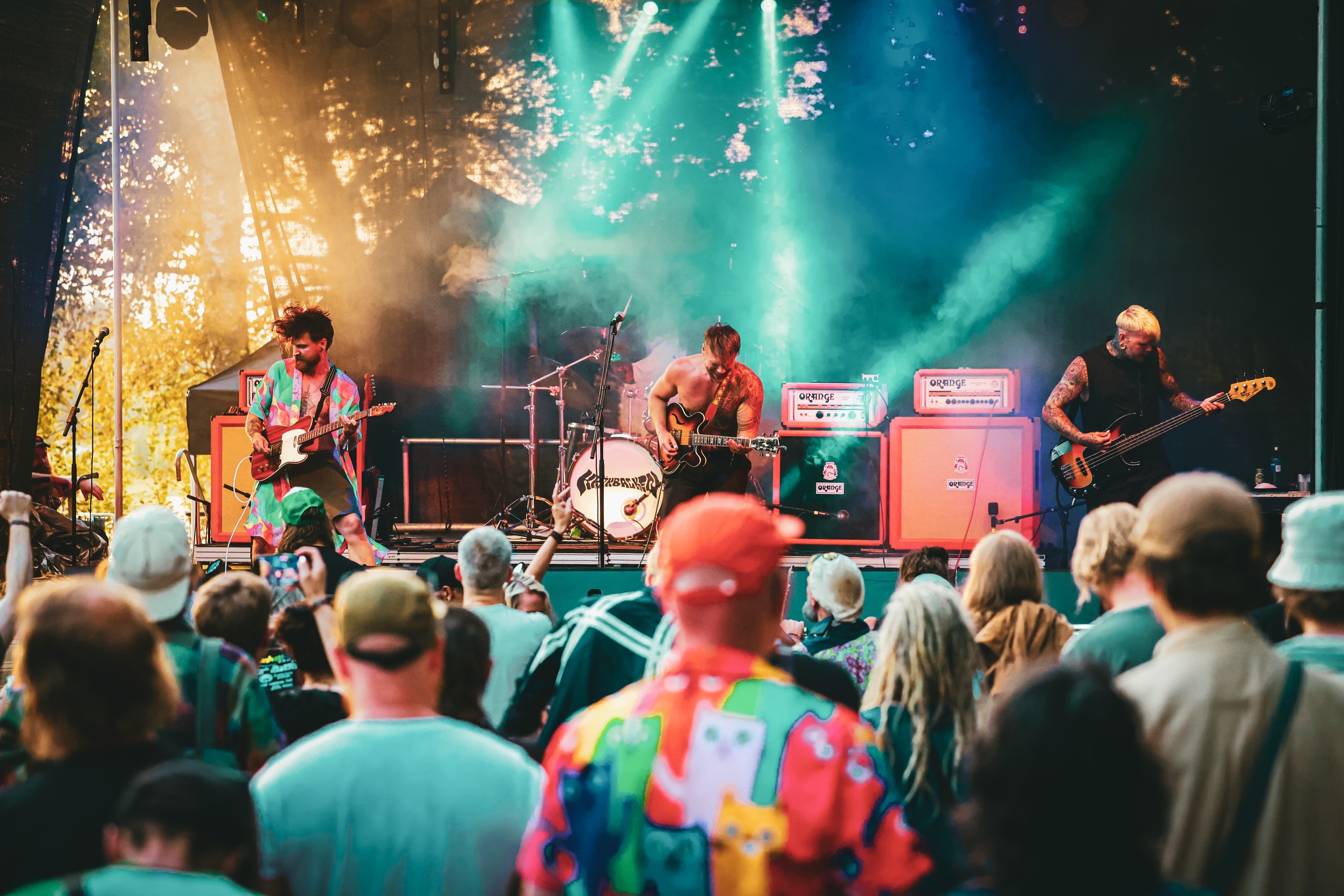
The festival circuit remains the primary discovery mechanism for psych rock specifically. Regional festivals like Normaltown are where careers get momentum. But getting on those festivals requires outreach, which requires time and consistency. Scheduled social posting, automated email sequences, AI-assisted pitch writing: these aren't glamorous, but they're the infrastructure that gets you from "playing in your city" to "playing in someone else's city."
Design Is No Longer a Budget Line Item
Visual identity used to be the thing that immediately gave away your budget. Major label releases have cohesive artwork, tour assets, press photos with consistent color grading, and social templates that actually look like they belong together. Independent releases often have, generously, vibes. A cool photo someone took, a font that seemed fine at the time, and a Canva template that 40,000 other artists also used.
AI image generation and design tooling have changed this more dramatically than almost anything else in the indie toolkit. The difference between a release that looks like a major label project and one that doesn't is now mostly a question of whether the artist spent two hours learning the tools, not whether they had a $2,000 design budget. Midjourney, Adobe Firefly, and purpose-built music industry design tools can generate album artwork, social assets, and press kit visuals that are genuinely competitive with what labels are producing.
This matters more than people admit. Streaming platforms are visual environments. Your thumbnail on a playlist is competing with artwork that had real money behind it. If yours looks like an afterthought, it gets treated like one. That's not a moral judgment, it's just how human attention works.
Data Is the Part Nobody Talks About Enough
Here's where the gap has historically been most brutal: analytics and audience intelligence. Major labels have teams who do nothing but analyze streaming data, social engagement patterns, and geographic audience clusters. They know which markets are responding to a release before the artist even knows it's happening. They can redirect promotional spend toward Hong Kong because they saw the numbers move there first.
And that's not hypothetical. The current international forecast for psychedelic rock shows genuine traction building in Asian markets, particularly Hong Kong, where Western garage-psych acts are finding audiences that have been underserved by major label attention. An independent artist with access to good analytics tools can see that signal and act on it. An independent artist without those tools just hopes a playlist editor somewhere noticed.
AI-assisted analytics platforms are making this kind of intelligence accessible at the indie level. Not the same depth as a label's proprietary data infrastructure, but enough to make informed decisions about where to focus promotional energy, when to release, and which audience segments are actually engaging. The workflow runs we're seeing at Indiependr reflect exactly this: artists using AI not to replace their creative instincts, but to make smarter decisions about where those instincts get deployed.
The Consistency Problem, and Why AI Actually Solves It
There's a thing that happens to independent artists around month three of trying to maintain a consistent online presence. The posts get less frequent. The quality drops. The strategy that made sense in January gets abandoned by April because life happened. Major labels don't have this problem because they have staff. Independent artists absolutely do.
AI doesn't get tired. It doesn't have a bad week. Scheduled social content, automated audience engagement, consistent visual output: these are the things that compound over time into an actual audience. The artists who are winning in fragmented indie genres right now aren't necessarily the most talented ones. They're the ones who show up consistently enough that the algorithm, and more importantly the audience, starts to trust them.
The Indiependr Lab is built around exactly this problem. Thirteen scheduled social posts, one active email mailbox, 58 music studio workflow runs: that's what early adoption looks like in practice. It's not flashy. But it's the kind of consistent output that, six months from now, starts to look like a career.
What AI Still Can't Do
It can't make your music better. It can't replace the year you spent developing a sound that's actually yours. It can't manufacture the kind of authentic weirdness that makes a psych rock act worth following. And it can't substitute for the live performance that, in this genre especially, is still the thing that converts a casual listener into someone who tells their friends.
The honest version of this argument is that AI gives independent artists the operational capacity to actually compete on marketing, design, and data intelligence. It doesn't give them the music. That part is still on you. But if you've got the music and you've been losing because you didn't have the infrastructure around it, the infrastructure is now affordable.
If this sounds like what you need, Indiependr is where we're building it.